Boxwoods are one of those garden plants that can make a landscape look instantly more established. Their dense evergreen foliage, tidy shape, and ability to be clipped into clean borders make them especially useful around walkways, entryways, flower beds, and the front of a home. But once the boxwoods are planted, there is often one problem: what should go in front of them? That narrow strip of garden at the base of a boxwood hedge can easily look unfinished or overly bare. The answer isn’t necessarily to add another shrub or a taller flowering plant. In many cases, the most beautiful solution is to create a low layer of plants in front of the boxwoods that softens their formal shape without hiding them. The best plants for this job depend heavily on how much sunlight the area receives. Fortunately, there are beautiful options for both sunny and shady locations, from flowering perennials and ornamental grasses to low-growing groundcovers and colorful foliage plants.
Why Plant in Front of Boxwoods?
Boxwoods already provide an important layer of structure in the garden. Because they remain evergreen, they give the planting bed shape even when many surrounding perennials have finished flowering for the season. Adding lower plants in front creates another layer.
Instead of seeing:
boxwood → empty soil → lawn or walkway
you get:
boxwood → low foliage and flowers → garden edge
This layered approach gives the garden more depth and makes the boxwoods feel integrated into the surrounding planting rather than standing alone. It also creates an opportunity to introduce things that boxwoods don’t provide themselves, such as flowers, softer foliage, movement, seasonal color, and different leaf shapes. Boxwoods generally perform well in full sun to part shade, although many varieties appreciate some afternoon shade. Good drainage is also important, so the plants growing around them should be suited to the same general conditions.
How to Choose Plants for the Front of Boxwoods
Before choosing a plant simply because it looks pretty, consider four things:
1. How much sun does the area receive?
A planting bed that receives six or more hours of direct sun will have very different options from a bed tucked beneath a porch, tree, or overhang. For this reason, the recommendations below are divided into sun-loving and shade-loving plants.
2. How tall will the plant eventually become?
This is especially important when planting directly in front of boxwoods. The goal is generally to keep the foreground layer low enough that it doesn’t completely hide the boxwood. Check the mature height and width of the particular variety rather than relying on how large the plant looks when you purchase it.
3. What texture will it add?
Boxwoods have small, dense, finely textured leaves and a naturally rounded or clipped form. Plants with dramatically different foliage can make the combination much more interesting.
Think:
✦Fine, grassy foliage
✦Large, rounded leaves
✦Silver foliage
✦Airy flowers
✦Mounding forms
✦Low spreading plants
4. Does it have similar growing requirements?
Companion planting works best when plants have compatible needs for light, moisture, soil, and drainage. A plant that needs constantly moist soil isn’t necessarily a good partner for a boxwood in a dry, sunny foundation bed.
Best Plants to Plant in Front of Boxwoods in Sunny Areas
If your boxwoods receive plenty of direct sunlight, you have a particularly large selection of low-growing companions.
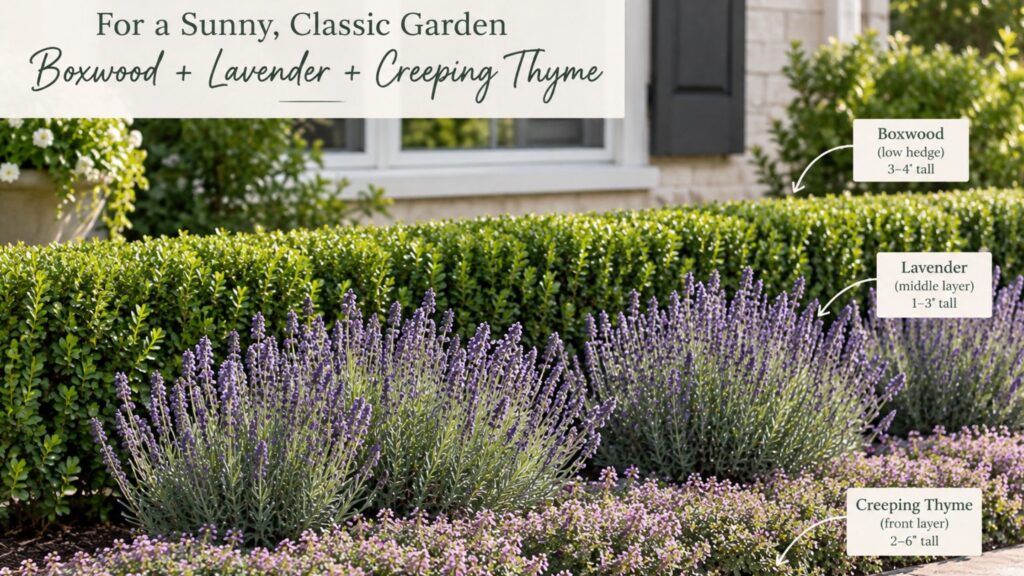
1. Lavender
Lavender is one of the prettiest choices for a sunny boxwood border. Its silvery foliage and purple flowers create an especially attractive contrast against the deep green of boxwood. The upright flower stems also add a little height without becoming a bulky shrub. Lavender prefers full sun and well-drained soil, making it particularly suitable for sunny, relatively dry planting beds.
Best for: Full sun, well-drained soil
Why it works: Silver foliage, purple flowers, contrasting texture
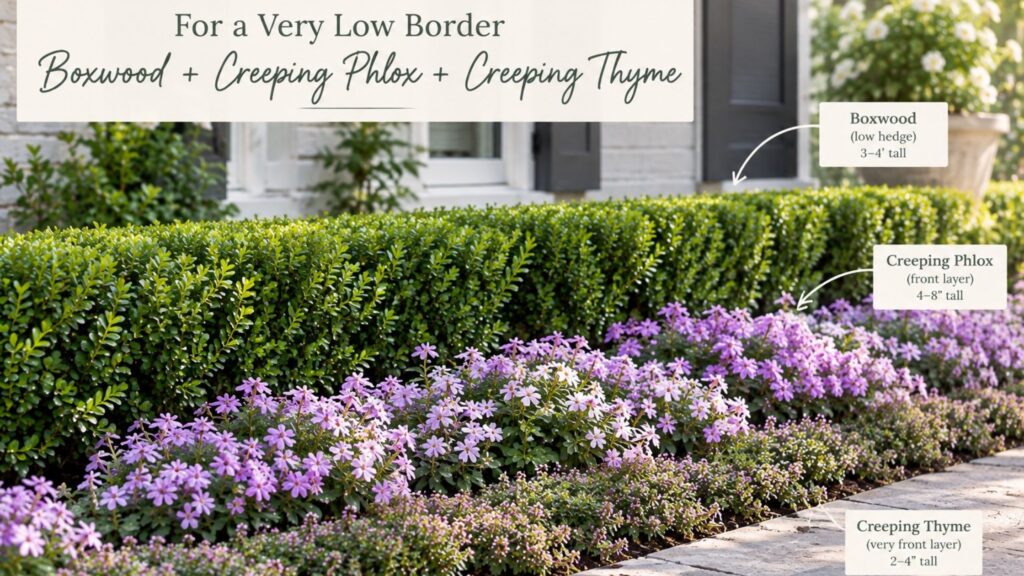
2. Creeping Phlox
For a lower layer that practically disappears beneath a blanket of flowers in spring, consider creeping phlox. It stays close to the ground and can spill gently toward the edge of a bed or walkway. The flowers are particularly effective against the dark green backdrop of boxwood.
Best for: Full sun
Why it works: Very low growth and abundant seasonal flowers
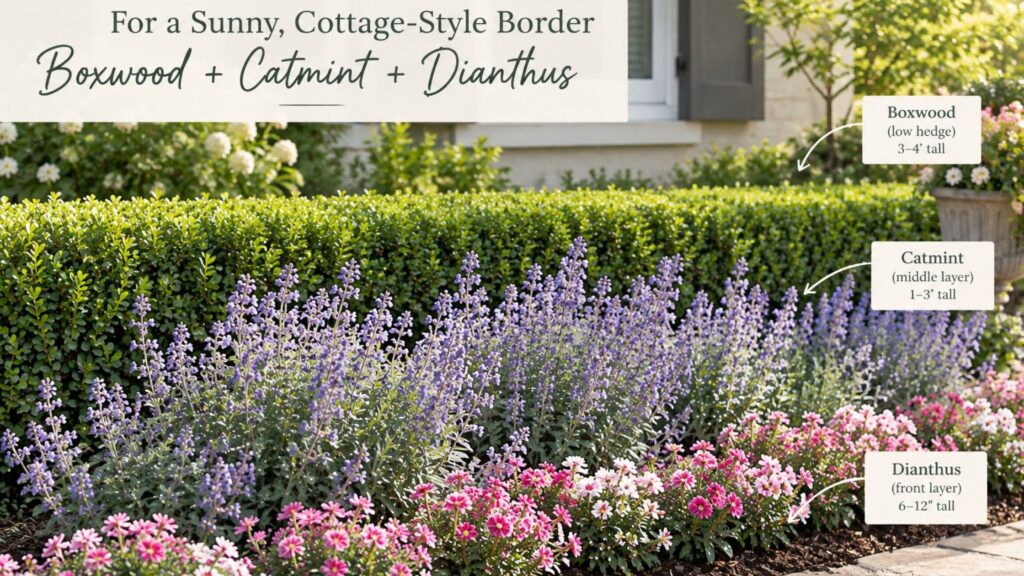
3. Catmint
Catmint is another excellent sunny companion when you want flowers without creating a tall or bulky planting. Its soft, gray-green foliage and lavender-blue flowers pair beautifully with evergreen shrubs. It can also give a more relaxed feel to a formal boxwood planting. Choose a compact variety if your goal is specifically to create a low foreground layer.
Best for: Sun to part sun
Why it works: Long flowering period, soft foliage, pollinator-friendly flowers
4. Creeping Thyme
Creeping thyme is a wonderful choice when the planting area needs to stay extremely low. It can form a dense mat of foliage and produces small flowers during its bloom period. It is particularly useful along the very front edge of a planting bed.
Best for: Full sun and well-drained soil
Why it works: Extremely low-growing and good for edging
5. Dianthus
Dianthus adds both flowers and interesting foliage without overwhelming a boxwood border. Depending on the variety, plants can remain fairly compact, making them useful toward the front of a layered planting. Pink, white, and reddish flowers also look particularly pretty against deep green foliage.
Best for: Sun to part sun
Why it works: Compact growth, colorful flowers, attractive foliage
6. Sedum
Low-growing sedums are excellent when you want something that hugs the ground. Their fleshy foliage introduces a completely different texture from the fine foliage of boxwood. Many varieties also produce clusters of small flowers.
Best for: Sunny, well-drained locations
Why it works: Low profile, interesting foliage, drought tolerance once established
7. Sweet Alyssum
If you’re looking for a softer, more informal look, sweet alyssum can be planted along the front of boxwoods. The tiny flowers create a delicate edge and can soften the transition between a formal hedge and a lawn or pathway. Sweet alyssum is also a particularly useful option when you want seasonal color rather than a permanent perennial planting.
Best for: Sun to part shade
Why it works: Very low, soft-looking, abundant flowers
8. Dwarf Ornamental Grasses
A small ornamental grass can provide an entirely different texture in front of boxwood. Look for genuinely compact varieties rather than large grasses that will eventually hide the shrubs. The fine blades create movement and contrast beautifully with the dense, clipped form of boxwood.
Best for: Sunny locations
Why it works: Adds movement and fine texture
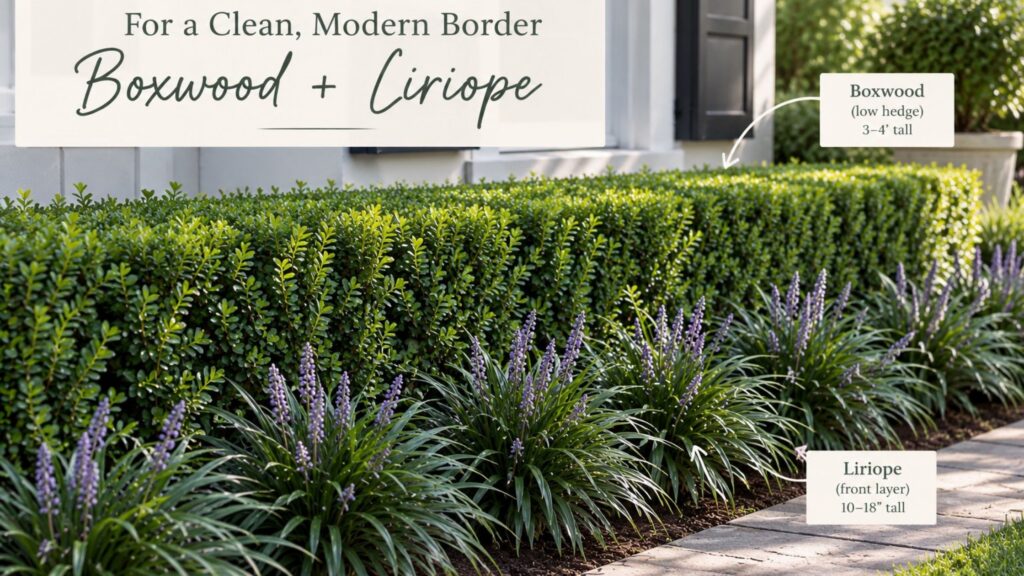
9. Liriope –LF favorite!!
Liriope is one of the most versatile choices for planting around boxwoods because it can tolerate both sun and partial shade. Its grass-like foliage creates a strong textural contrast with boxwood, while its small flowers add seasonal interest. It works particularly well when repeated along the entire length of a boxwood border rather than planted as a single specimen.
Best for: Sun to part shade
Why it works: Evergreen or semi-evergreen foliage, grass-like texture, easy repetition
10. Creeping Rosemary or Compact Rosemary
In warm enough climates, a low-growing rosemary can be beautiful alongside boxwoods. The blue flowers and needle-like foliage contrast with the rounded, dense shape of the shrub, while the foliage also brings fragrance to the garden. Because rosemary prefers excellent drainage and plenty of sun, it is best reserved for the appropriate climate and planting conditions.
Best for: Full sun and excellent drainage
Why it works: Fragrance, blue flowers, dramatically different foliage
Best Plants to Plant in Front of Boxwoods in Shade
A shady boxwood border doesn’t have to be boring. In fact, shade opens up some particularly beautiful foliage combinations. Instead of relying entirely on flowers, use plants with different leaf shapes, colors, and textures to create depth.
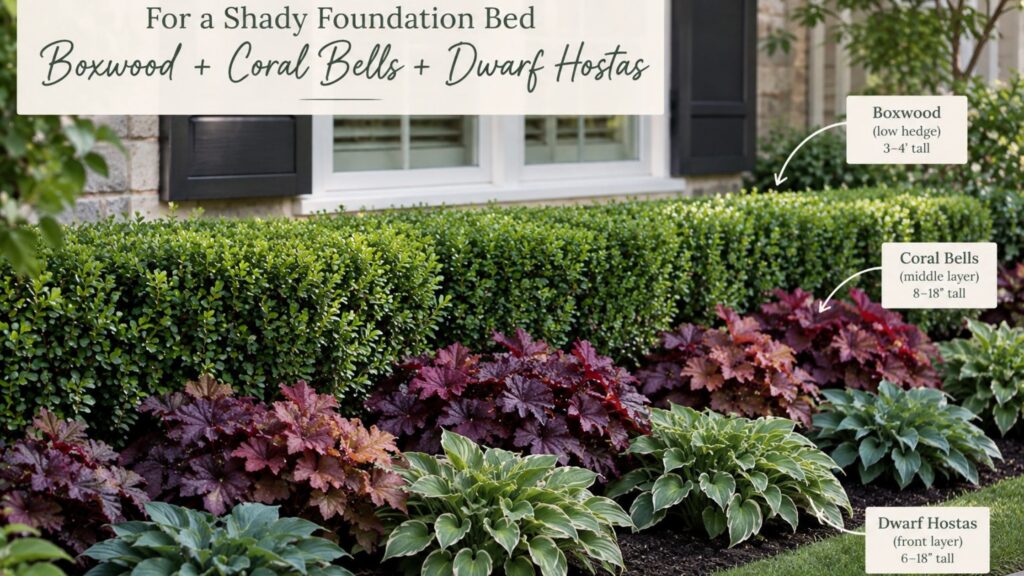
11. Coral Bells
Coral bells, or heuchera, are one of my favorite choices for the front of boxwoods. Their rounded, mounding foliage creates a beautiful contrast with the small leaves of boxwood, and varieties are available in shades ranging from green and silver to burgundy, bronze, and caramel. This makes coral bells especially useful if you want color even when the plants aren’t flowering.
Best for: Part shade to shade, depending on variety
Why it works: Colorful foliage and compact mounding habit
12. Hosta
Hostas are classic shade-garden plants for a reason. Their broad leaves provide a dramatic contrast against boxwood’s small foliage. However, because some hostas become quite large, choose dwarf or smaller varieties when planting directly in front of a boxwood hedge. Blue-green, green, gold, and variegated foliage can all create different effects.
Best for: Part shade to shade
Why it works: Large contrasting leaves and dependable foliage
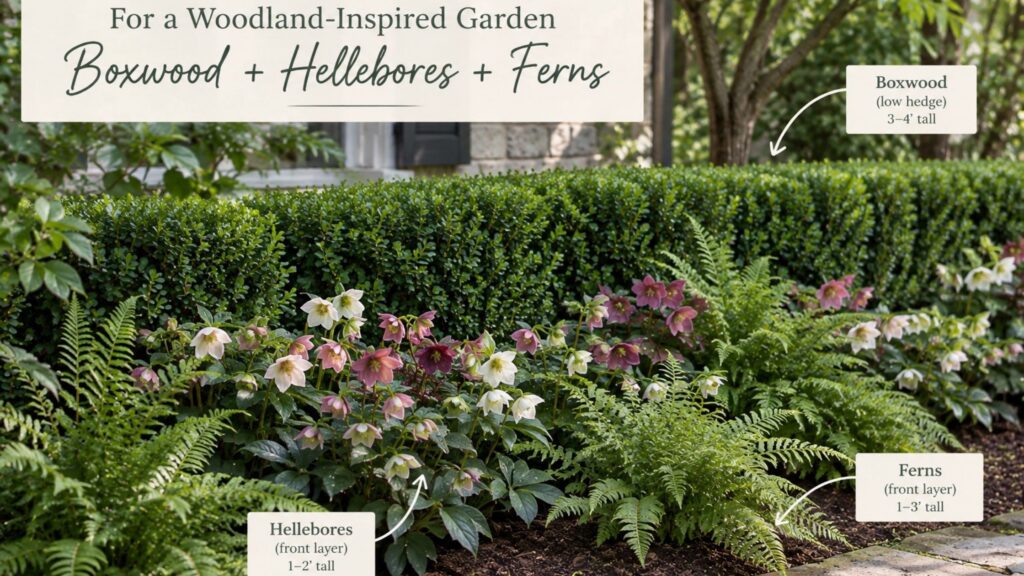
13. Hellebores – LF favorite!!
Hellebores are an excellent choice when you want flowers in a shady garden. Their attractive foliage provides structure close to the ground, while their flowers appear at a time of year when many other plants are still dormant. They can also contribute to a more natural, woodland-inspired look while still working beautifully with the formality of boxwood.
Best for: Part shade to shade
Why it works: Early-season flowers and attractive evergreen foliage
14. Carex
For something completely different, consider a low-growing ornamental sedge such as a compact Carex variety. The fine, arching foliage creates movement and texture without competing with the boxwood’s form. There are many varieties, so check the individual plant’s mature size and light requirements before planting.
Best for: Part shade to shade, depending on variety
Why it works: Fine texture and graceful movement
15. Ferns
Small ferns can create a softer, more woodland-inspired layer in front of boxwoods. Their delicate fronds are almost the opposite of the dense, geometric structure of a clipped boxwood, which makes the combination particularly interesting. Choose compact varieties appropriate for the amount of shade and moisture available.
Best for: Shade and part shade
Why it works: Soft, airy texture
16. Astilbe
Astilbe works beautifully in a shady planting bed when there is adequate moisture. Its fern-like foliage provides texture, while the tall, feathery flowers rise above the foliage for a light, airy effect. Because some varieties become fairly large, select a compact cultivar if the goal is specifically to create a low foreground layer.
Best for: Part shade and consistently moist soil
Why it works: Delicate foliage and feathery flowers
17. Sweet Woodruff
Sweet woodruff can create a beautiful low layer beneath and around larger plants in shady conditions. Its small white flowers provide spring interest, and its foliage creates a soft green carpet. However, it can spread vigorously in favorable conditions, so it should be used thoughtfully and checked against local invasive-plant guidance before planting.
Best for: Shade to part shade
Why it works: Low, spreading foliage and small white flowers
Plants That Work in Both Sun and Part Shade
If you’re dealing with a garden that receives changing amounts of light throughout the day, there are a few especially versatile options from the lists above:
Liriope
One of the easiest choices for creating a repeated border in both sunny and partially shaded areas.
Coral Bells
Many heuchera varieties can tolerate a range of light conditions, although the ideal exposure varies by cultivar.
Dianthus
Some varieties can work in part sun, particularly where they still receive several hours of direct light.
Sedum
Many sedums prefer full sun, but specific varieties can tolerate some light shade.
Creeping Phlox
Best in sun, but can tolerate some light shade depending on the variety and growing conditions.
The important thing is not to treat “sun” and “shade” as interchangeable labels. A north-facing foundation bed, bright filtered light beneath a tree, and a garden receiving six hours of afternoon sun are three very different environments.
How to Layer Plants in Front of Boxwoods
Choosing the plants is only half of the equation. Placement is what makes the planting look intentional. A simple way to think about the bed is to work from back to front.
Back layer: Boxwoods
Your boxwoods provide the permanent structure. Their evergreen foliage is the tallest and most consistent layer.
Middle layer: Low mounding plants
Add plants such as coral bells, compact hostas, catmint, dianthus, or liriope depending on the light conditions. These plants should be low enough that the boxwoods remain visually dominant.
Front layer: Very low plants
This is where creeping thyme, creeping phlox, sedum, sweet alyssum, or another low groundcover can work beautifully. The plants can gently lead the eye toward the edge of the bed, lawn, or walkway. This tall-to-short progression is one of the simplest ways to create depth in a planting bed. Extension guidance similarly recommends thinking in layers, with taller plants behind and lower, spreading plants toward the front edge.
Should You Plant Directly Against the Boxwoods?
Not necessarily. It can be tempting to completely fill the space around the base of a boxwood, but giving plants enough room to grow is important. Boxwoods have relatively shallow roots, so planting an aggressive or very thirsty companion immediately against the shrub can create unnecessary competition. Good air circulation and appropriate spacing are also important for overall plant health. Instead of thinking about filling every inch of soil, think about creating a layered planting composition.
You want the companion plants to visually connect with the boxwoods without swallowing them. And always check the mature width of each plant. A tiny perennial purchased in a nursery pot can look completely different two or three years later.
What About Planting Groundcovers Around Boxwoods?
Groundcovers can be particularly attractive because they create a low carpet beneath taller plants. However, this is an area where plant selection matters. For example, some commonly recommended groundcovers can spread aggressively or may create problems depending on the region. Japanese and Allegheny pachysandra are also worth approaching cautiously around boxwoods because extension guidance has noted that pachysandra can be affected by boxwood blight.
Instead of choosing a groundcover simply because it is fast-spreading, consider plants that will stay within the area you actually want them to occupy. A low-growing plant that stays where you planted it is often much more useful than one that takes over the entire bed.
Don’t Forget Seasonal Interest
One of the biggest advantages of using boxwoods as the foundation of a planting bed is that you don’t have to ask every companion plant to provide year-round interest. The boxwood is already doing that job. This means you can use flowering perennials that disappear or become dormant during winter without ending up with a completely empty garden.
Spring bulbs can also be tucked into the foreground of an established planting. Snowdrops, crocuses, and grape hyacinths are examples of early-season bulbs that can bring color to the garden before many perennials have begun their main growth. The boxwood remains the constant while the plants in front of it change throughout the seasons. That is what makes layering so effective.
Final Thoughts
Boxwoods don’t need much help to look beautiful, but the right plants in front of them can completely change the feel of a garden. The goal isn’t to compete with the boxwood or hide its clean evergreen shape. Instead, think of the boxwood as the anchor and the plants in front as the softer, more colorful layer that connects it to the rest of the landscape.
For sunny gardens, plants such as lavender, creeping phlox, catmint, creeping thyme, dianthus, sedum, sweet alyssum, and liriope can add flowers, texture, and movement. For shadier locations, coral bells, dwarf hostas, hellebores, ferns, Carex, and astilbe offer beautiful foliage and seasonal interest without requiring a sunny flower bed. And if you’re working with a particularly narrow space, don’t feel pressured to fill it with multiple varieties. Sometimes a simple repeated border of one low-growing companion plant looks far more polished than a collection of unrelated flowers.
The most successful boxwood borders usually come down to three things: matching the plants to the light, choosing varieties that stay appropriately low, and layering different textures rather than simply adding more plants. Once you start looking at the garden in layers, that empty space in front of the boxwoods becomes less of a problem—and more of an opportunity.